When you’re in Pre-sales, you rarely have the luxury of weeks to fine-tune a proposal.
Yet, the most successful bids have one thing in common: a clear, memorable Win Theme.
It’s the red thread that ties your solution to the customer’s deepest priorities — and it’s what they remember in the decision room.
When I was the Presales Lead at a leading IT services company, we had a high-stakes RFP for a logistics giant.
We had less than a week to respond, and the competition had been embedded with the client for months.
On Day 1, the account team sent me a 60-slide deck stuffed with features, certifications, and process diagrams.
It looked impressive — but it didn’t say anything.
I called a quick huddle and asked everyone:
At first, we got five different answers. After 20 minutes of debate, we nailed it down to:
“Cut their shipment delays by 40% without changing their existing carriers.”
That became our win theme.
Every slide, every proof point pointed back to it.
We didn’t win because we had the most slides — we won because our message was simple, repeatable, and aligned to their biggest pain.
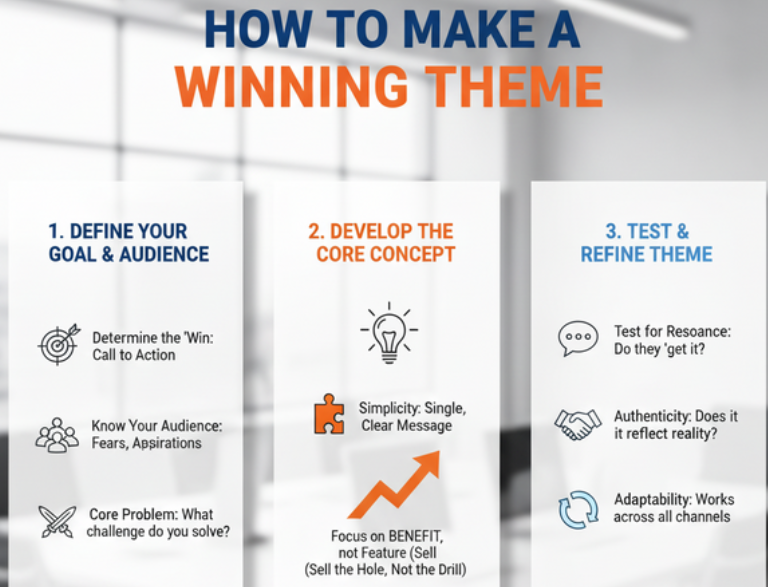
The good news? You can build a powerful Win Theme in 30 minutes or less by combining a few simple frameworks with sharp thinking. Here’s my exact process, plus some mental models and thumb rules I’ve refined over a decade of deal architecture.
Step 1: Anchor to the Customer’s #1 Priority (5 minutes)
Before you open PowerPoint, ask:
“If my customer only remembers one thing from my pitch, what should it be?”
Thumb Rule: The win theme must pass the Boardroom Repeat Test — can a CXO repeat it to their peers without reading your slides?
Mental Model: Pain–Impact–Solution
- Pain: What problem hurts the most right now?
- Impact: Why fixing it matters (financially or strategically).
- Solution: How your offer directly addresses it.
Step 2: Distill It Into One Sentence (10 minutes)
Avoid jargon. Be crisp.
Example:
We deliver an agile, cloud-native, API-first solution.- ( Not the right message)
We cut your onboarding time from 6 weeks to 6 days.- ( Correct way)
Thumb Rule: If your win theme doesn’t fit in a single Tweet (280 characters), it’s too long.
Step 3: Wrap It in a Value Lens (5 minutes)
Customers buy outcomes, not features.Decide which value lens your theme sits in:
- Revenue growth (help them sell more)
- Cost reduction (help them save more)
- Risk mitigation (help them lose less)
Mental Model: Three-Lens Filter — every claim you make should pass through at least one of these lenses.
Step 4: Support It With Three Proof Points (7 minutes)
Your win theme is the headline — now give them the sub-headlines.
Proof points can be:
- A customer success story
- A quantifiable metric
- A competitive differentiator
Thumb Rule: Never use more than 3 proof points — decision-makers won’t remember more anyway.
Step 5: Pressure-Test It (3 minutes)
Read it aloud as if you were the customer.
Ask yourself:
- Is it obvious how this helps me?
- Does it sound different from what your competitors are saying?
If the answer is “maybe” or “sort of” — refine again.
Conclusion
A win theme isn’t just a tagline. It’s the strategic heartbeat of your proposal.
In just 30 minutes, you can craft one that’s memorable, customer-focused, and backed by proof.
For more pre-sales strategies,
Also Read: What Is a Request for Proposal (RFP)? A Complete Business Guide you’ll see how templates and win themes work hand-in-hand to win deals.