
A few years ago, my team responded to an RFP we had no business bidding on.
The client was in a sector we barely understood. The timeline was brutal — 10 days to submit a 70-page response. We had two practice leads on leave. And the deal size, while attractive on paper, required margins we couldn’t defend.
But the RFP landed on a Friday afternoon, someone senior said “let’s go for it,” and by Monday morning, six people were heads down writing content that would never be read by anyone who mattered.
We lost. Badly.
The client had already shortlisted two vendors before the RFP was even issued. We were invited to make the process look competitive.
That’s not a story about losing. That’s a story about the real cost of a bad bid decision — and the discipline it takes to build a better one.
The Trap That Catches Most Pre-Sales Teams
Here’s the thing nobody says out loud: most pre-sales teams are structurally rewarded for saying yes.
More bids = more pipeline = more activity metrics = happy leadership.
The problem is, this math only works until you calculate win rates. Teams that chase every RFP tend to win fewer of them — not because they’re less capable, but because their energy, attention, and best writing is spread too thin.
A bid is not just a document. It’s a commitment. Every RFP you respond to pulls skilled people away from the deals that actually have a chance.
The bid/no-bid decision is the first strategic call in any pursuit — and it’s the one that gets the least deliberate attention.
What Bid/No-Bid Actually Means
A bid/no-bid decision is exactly what it sounds like: a structured evaluation of whether to formally respond to an RFP or walk away from it.
But in practice, it’s less about the document and more about the situation behind it.
Before you write a single word of a response, you need to ask: Do we understand this client’s world well enough to shape a compelling story — and do we have the right to win?
That’s the real question. Not “can we fulfill the requirements?” Almost everyone can. The question is whether you can win— and whether the investment is worth it.
The 5 Questions to Ask Before You Commit
This is the framework I use. It’s not complicated, but it requires honest answers — not optimistic ones.
1. Do We Know This Client?
Have you met them before? Spoken to their team? Do you understand what’s actually driving this RFP — is it a genuine need, a budget cycle, a competitive pressure?
If you are discovering the client for the first time through their RFP, you are at a significant disadvantage. Clients rarely select vendors they’ve never spoken to, especially for complex, long-term engagements.
Minimum bar: You should be able to name the business problem behind the requirement — not just the requirement itself.
2. Do We Have a Differentiated Position?
Read the evaluation criteria closely. Not to check boxes — to understand what the client actually values.
Now ask yourself: where do we genuinely stand out? Not in general. Specifically, for this client, against the likely competitors.
If you can’t articulate two or three reasons why your approach is meaningfully different — not just competitive — you don’t have a position. You have a submission.
Minimum bar: You should be able to finish this sentence clearly — “We are the right choice for this client because ___.” If it sounds generic, it probably is.
3. Can We Resource This Properly?
Bid quality is a direct function of the time and expertise you put into it. A half-built response damages your credibility more than a no-bid.
Look at your team’s actual availability. Who needs to write content? Who needs to review it? Who needs to pull in SME inputs from delivery and practice heads?
If the answer to any of these is “we’ll figure it out,” that’s a yellow flag.
Minimum bar: At least 60–70% of the core team needed for this bid should be confirmed available before you commit.
4. Is the Timeline Realistic?
Tight RFP timelines are either a signal of a disorganized procurement team — or a sign the decision is already made and you’re filling a compliance slot.
Neither is good.
Map out the key milestones: when does the draft need to be ready? When do you need internal review? When does pricing need to be finalized? If the math doesn’t work, the quality won’t either.
Minimum bar: You need enough time for at least one full internal review cycle before submission.
5. Does the Commercial Opportunity Make Sense?
Not just the headline number — the full picture.
What’s the likely margin? What’s the cost of pursuit? How long will this deal take to close? And if you win, can you actually deliver profitably?
Some deals look attractive at the top line and quietly destroy you in delivery. Pre-sales should have a view on this before the proposal is written, not after the contract is signed.
Minimum bar: You should be able to sketch a rough commercial case that your delivery and finance teams would not immediately push back on.
The Hidden Signals in an RFP
Beyond the five questions, the RFP document itself often tells you something about your real chances — if you know how to read it.
Watch for these:
- Hyper-specific technical requirements that match a particular vendor’s product footprint almost exactly. This can mean someone helped write the RFP.
- Unrealistic timelines with no clear justification. Usually means the outcome is pre-decided.
- Minimal evaluation weight on experience or approach, with heavy weight on price. In complex engagements, this is often a sign the buyer doesn’t fully know what they need — or doesn’t plan to evaluate seriously.
- No discovery meeting or vendor Q&A session offered. Clients who are serious about finding the right partner build in dialogue. Those who are not, don’t.
None of these signals are absolute. But they are information. And good pre-sales professionals read RFPs twice — once for the content, once for what’s not being said.
What Walking Away Actually Wins You
This is the part that feels uncomfortable until you’ve experienced it.
When you decline to bid on an RFP you cannot win — or cannot resource well — you do not lose that deal. You reclaim the capacity to do your best work on the deals you can actually win.
There is also a less obvious benefit: it signals confidence.
A no-bid, communicated well, tells a client: We take proposals seriously. When we show up, we’re ready. That reputation compounds over time. Clients remember the vendors who said “this isn’t right for us right now” — and they respect them more when they do show up.
Contrast that with a team that responds to everything and wins nothing. Clients notice that too.
The best bid teams I’ve seen are selective by design, not by accident.
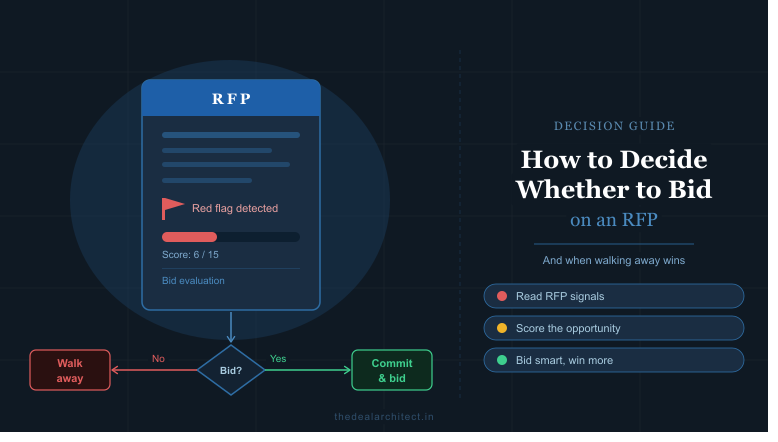
A Simple Scoring Guide
If you want something concrete to apply, score each of the five questions on a 1–3 scale:
- 1 = Weak / No
- 2 = Partial / Maybe
- 3 = Strong / Yes
Total possible: 15 points
- 12–15 → Strong bid. Commit and invest properly.
- 8–11 → Conditional bid. Identify what needs to be true to justify pursuit. Don’t proceed without resolving the gaps.
- Below 8 → Walk away. Or have an honest internal conversation about why you’re still considering it.
This won’t make the decision for you. But it will make the conversation more honest.
Closing Thought
The bid/no-bid decision is not a bureaucratic gate. It’s a test of strategic discipline.
Anyone can say yes to an RFP. The harder skill — and the more valuable one — is knowing when not to.
In a world where client attention is scarce and proposal resources are never truly unlimited, how you choose to spend your pursuit energy matters as much as how you spend it.
Bid smart. Show up fully. Walk away when you need to.
The deals you win will be better for it.
Related posts:
No related posts.